Down the Stairs and Into the Past: What Michigan Basements Are Really Hiding
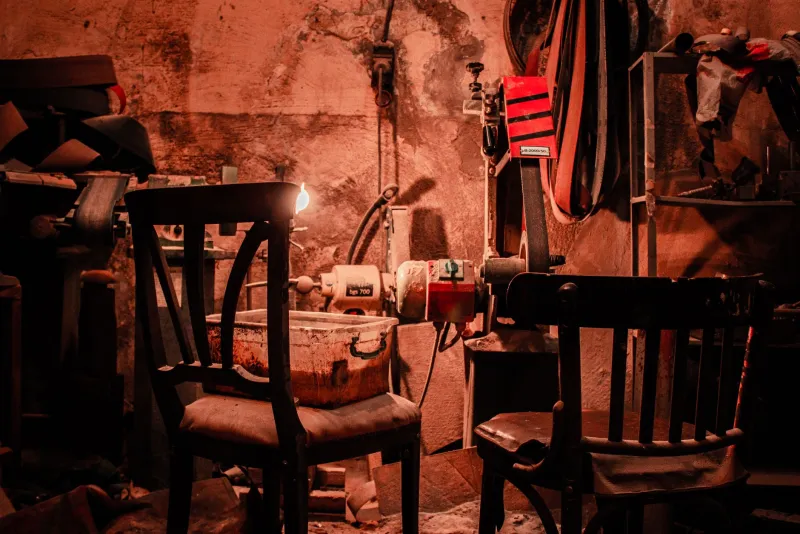
You know the smell. That particular combination of concrete, old cardboard, and something vaguely damp that hits you the second you pull open the door at the top of the stairs. If you grew up in Michigan, that smell is practically a memory trigger — one whiff and you're eight years old again, hunting for a board game while your parents host a cookout upstairs.
Michigan basements are their own category of place. They're not quite storage units, not quite living spaces, and definitely not the Pinterest-ready "finished lower levels" you see on home renovation shows. They're something more honest than that. More layered. More Michigan.
They are, in a very real sense, where we keep ourselves.
The Unofficial State Archive
Drive through any neighborhood in Lansing, Marquette, Flint, or Kalamazoo and you'll find homes sitting on top of decades of accumulated life. Fishing rods from grandfathers who've been gone for twenty years. Canning jars lined up like soldiers on wooden shelves someone built before the moon landing. A chest freezer that's been humming since the Carter administration.
Karen Pietrzak, who grew up in a Polish-American household in Hamtramck, spent three weekends last spring cleaning out her mother's basement after the family home sold. What she found reads like an inventory of a very specific Michigan life: two sets of cross-country skis, a VHS copy of the 1984 Detroit Tigers World Series highlights, approximately forty pounds of venison-processing equipment, and a cookie tin that turned out to contain not cookies but her grandfather's naturalization papers.
"I sat on the basement floor and cried for about twenty minutes," she says. "I didn't even know those existed. Nobody did. He never talked about coming over from Poland. And there it was, just sitting in a tin next to a broken Shop-Vac."
That's the thing about Michigan basements. They don't organize themselves by importance. The profound and the mundane coexist down there without any particular hierarchy.
Motown in the Milk Crates
If Michigan has a soundtrack — and it absolutely does — a significant portion of that soundtrack is currently sitting in a milk crate in someone's basement.
Record collectors across the state have long known that estate sales and basement cleanouts are where the real finds happen. Vinyl that never made it to a store, regional pressings, promotional copies of Motown releases that somehow ended up in a suburban home in Dearborn or Royal Oak — these things surface regularly, usually discovered by a grandkid who didn't even know grandma had a turntable.
Detroit music culture has always had a way of seeping into everyday Michigan life, and the evidence turns up below ground level with surprising frequency. Barry Holloway, a record dealer out of Ypsilanti, says he's bought collections from basements that included original Motown 45s still in their sleeves, completely forgotten by families who just thought they were "old records."
"People don't realize what they have," he says. "Or they know it's something, but they don't know it's that something. I've paid for a kid's college semester with what I found in a single milk crate in a basement in Inkster."
The Hunting Room That Time Forgot
Outside the metro areas, Michigan basements take on a different character — though they're no less packed with history.
In the Upper Peninsula and across the rural stretches of the Lower Peninsula, the basement has traditionally served as the unofficial headquarters of hunting and fishing culture. Decoys hand-carved by great-uncles. Antlers mounted on plywood. Tackle boxes with lures that haven't been manufactured since the Eisenhower era. Blaze orange gear in sizes that haven't fit anyone in the family for three decades.
These aren't just objects. They're the physical residue of ritual — of opener weekends, of camps in the woods, of the particular Michigan tradition of men and women disappearing into the wilderness every November and coming back changed in ways they can't quite articulate.
Troy Makinen, who inherited his family's property near Houghton Lake, found his late father's deer camp journal tucked inside a hunting vest hanging on a nail in the basement. Forty years of entries. Every buck taken, every miss, every year the camp flooded, every year someone new was brought along for the first time.
"It's like a family Bible, except it's about deer," Troy says, laughing. "But honestly? It kind of is a family Bible. That's our whole history in there."
The Boxes Nobody Opens
Every Michigan basement has at least one. Usually more.
The sealed boxes. The ones with no labels, or labels in handwriting nobody recognizes, or labels that simply say things like "MISC" or "DAD'S STUFF" or, cryptically, "NOT FOR GARBAGE." These boxes exist in a state of collective family suspension — nobody wants to open them, nobody wants to throw them away, so they migrate from house to house across generations, accumulating a kind of mythological weight.
Sometimes the contents are anticlimactic. Old magazines. Broken clock parts. A truly baffling number of rubber bands.
But sometimes they're not.
Janelle Ostrowski, who grew up in Grand Rapids and recently helped clear out her aunt's home, opened a box marked only with a year — 1971 — and found a complete set of handwritten letters between her grandparents during a period when her grandfather was working in the auto plants in Flint while her grandmother stayed in Poland waiting for her visa. Love letters. Angry letters. Heartbroken letters. A correspondence that painted a portrait of a marriage and a migration that the family had only ever known in the vaguest terms.
"We knew they came over. We knew it was hard," Janelle says. "But we didn't know any of this. We didn't know who they were before they became our grandparents."
Why We Keep It All
There's something specifically Midwestern — specifically Michigan — about the refusal to let things go. It's not hoarding, exactly. It's more like a deeply held belief that objects carry meaning, that throwing something away is a kind of erasure, and that you never quite know when something is going to matter again.
Michigan is a state that understands reinvention. Its cities have reinvented themselves. Its industries have transformed. Its people have survived economic hits that would have scattered other communities. And through all of it, the basements held the record. The proof that something was here, that people lived and worked and loved and built things worth keeping.
Maybe that's why cleaning out a Michigan basement always feels like more than just cleaning. It feels like archaeology. Like excavating a version of yourself you didn't know existed.
So the next time someone in your family mentions that the basement "really needs to get sorted out," maybe don't rush it. Go slow. Open the boxes carefully. There's a good chance something down there has been waiting a long time to be found.
And it probably smells like concrete and old cardboard and everything you forgot you were.