Ghosts in the Food Court: How Michigan's Fading Malls Became Shrines to Our Collective Memory
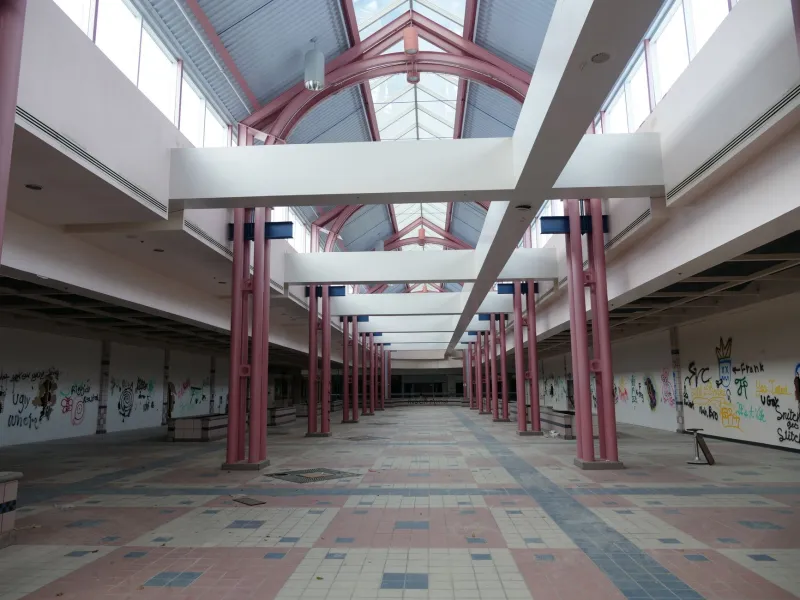
There's a particular kind of quiet that only exists inside a dying mall. It's not the silence of an empty field or an abandoned house. It's the silence of a place that used to be loud — full of sneaker squeaks on polished tile, the hiss of an Orange Julius machine, the background hum of a thousand Saturday afternoon conversations. Walk into one of Michigan's struggling shopping centers today and you can almost still hear it.
And apparently, a lot of people want to.
Across the state, a genuinely unexpected thing is happening: people are making pilgrimages to malls not because they want to shop, but because they want to remember. Urban explorers with camera bags. Families revisiting the anchor stores where they bought back-to-school shoes in 1994. TikTokers filming moody walkthroughs. Historians and preservationists quietly arguing about what these buildings actually mean. Michigan's malls, of all things, have become destinations.
The Mall as a Michigan Institution
To understand why this is hitting different here, you have to understand what the mall meant to Michigan specifically. This state built its 20th-century identity around industry, community, and the particular kind of optimism that comes with economic momentum. When the big enclosed malls went up in the '60s, '70s, and '80s, they weren't just retail centers — they were civic statements. They were the place. The place to see people, to be seen, to kill a winter afternoon when you'd already exhausted every other option in a state that averages 130 cloudy days a year.
Malls like Lakeside in Sterling Heights, Briarwood in Ann Arbor, and Meridian Mall in Okemos weren't just buildings. They were social infrastructure. First jobs, first dates, first tastes of independence for teenagers who'd finally talked their parents into dropping them off unsupervised. For a lot of Michiganders, the mall was the closest thing to a town square that suburban life offered.
Which makes watching them fade out — slowly, unevenly, one anchor store at a time — feel like something more than just a retail story.
Why People Keep Going Back
Ask someone why they drove forty minutes to walk through a half-empty mall on a Tuesday and you'll get answers that don't have much to do with shopping.
"It's like visiting somewhere that exists in two time periods at once," says Dani, a graphic designer from Ferndale who documents Michigan's changing commercial spaces on her Instagram. "You're standing in the present, but everything around you is pointing backward. The architecture, the signage, the way the light comes through those skylights — it was all designed for a world that doesn't quite exist anymore."
That tension — between what was and what is — is exactly what's drawing people in. Urban explorers have been cataloguing Michigan's emptying malls for years, but recently the audience for that content has expanded well beyond the niche. Videos of quiet mall walks in Michigan routinely rack up hundreds of thousands of views. There's a whole aesthetic built around it: soft fluorescent light, the lonely carousel that still spins twice a day on a timer, the Sunglass Hut that somehow outlasted everything around it.
Photographers are particularly drawn to the visual drama. The geometry of a mall — long corridors, repeated storefronts, the cathedral-like atrium — creates compositions that feel almost cinematic when half the stores are papered over. Michigan's malls offer that in abundance, and without the aggressive security presence you might encounter elsewhere.
The Bittersweet Economics Behind It All
It would be dishonest to celebrate this phenomenon without acknowledging what it represents. Michigan's mall decline isn't just a retail trend — it's a mirror held up to decades of economic turbulence. The same forces that hollowed out manufacturing communities hit the commercial spaces those communities supported. When plants closed and populations shifted, the malls felt it. When online shopping accelerated in the 2010s, they felt it again.
Some Michigan malls have managed to pivot — converting anchor spaces into medical facilities, trampoline parks, or mixed-use developments. Others are genuinely in limbo, surviving on a skeleton crew of tenants and a slowly dwindling base of loyal regulars. A few have closed entirely, leaving behind structures that communities aren't quite sure what to do with.
The nostalgia tourism happening around these spaces is real, but it exists alongside real grief. For every photographer who finds the emptiness beautiful, there's a former retail worker who lost a decent job when their location shuttered, or a small business owner who watched foot traffic disappear year by year. The aesthetic and the economic reality aren't always easy to hold at the same time.
What the Regulars Know
Here's what often gets missed in the broader conversation about dying malls: some of them aren't dead yet, and the people who still use them aren't being ironic about it.
Walk into Briarwood on a weekday morning and you'll find the mall walkers — retirees who've been doing their daily laps through those corridors for twenty years, rain or shine, regardless of what's open. They know the security guards by name. They have opinions about which hallway is drafty. They've watched stores come and go and kept showing up anyway.
These are the people who understand the mall most honestly: not as a symbol or a subject for photography, but as a place that still serves a purpose, even a reduced one. Their presence is its own kind of argument about what community infrastructure actually means — and what gets lost when we let it disappear entirely.
The Preservation Question Nobody's Quite Ready to Answer
As Michigan's malls continue their slow transformation, a harder question is starting to surface: what do we actually owe these buildings?
Some preservationists argue that the architectural history of mid-century commercial design is worth protecting — that the sweeping atria and distinctive facades of certain malls represent a genuine chapter in American design history. Others are more pragmatic, focused on adaptive reuse that serves current community needs rather than preserving the shell of a retail model that isn't coming back.
What's interesting is that the nostalgia tourism itself might be part of the answer. When enough people care about a place — even for complicated, bittersweet, aesthetically-driven reasons — it creates a kind of cultural pressure that keeps the conversation alive. Michigan's malls aren't going to survive as malls. But the fact that people keep returning to them, keep photographing them, keep talking about what they meant, suggests that whatever replaces them will need to carry some of that weight forward.
Go See One Before It Changes Again
If you've been thinking about taking one of these drives — and based on the view counts on those mall walkthrough videos, plenty of you have — there's no better time. The experience is genuinely strange and genuinely moving in equal measure. Bring a camera if that's your thing. Or don't. Just walk the corridors slowly and pay attention to what your memory does.
Michigan has always been good at holding onto things that the rest of the country moves past too quickly. Our malls, fading and stubborn and quietly full of ghosts, are just the latest example.